
A surreal cosmic drama unfolded in the gaming world this week, proving once again that the human capacity for rational debate can survive—even when one side insists the sky is a painted dome. Esteban 'NanoFRYS' Gomez and Will 'TeQ' Starck, two well-known figures in the Apex Legends competitive scene, held a public discussion on stream that rapidly abandoned weapon metas and drop zones to tackle a far more fundamental question: Is the Earth flat or round? The clash was not a typical esports rivalry but a philosophical tug-of-war that felt like an astronaut arguing with a cave painting about the existence of the sun.
Gomez, who adopted his flat-Earth conviction after watching a two-hour online documentary, approached the conversation with the certainty of a man who had decoded a hidden truth. Starck, on the other hand, brought credentials that could make a comet jealous: he is an aerospace engineer who earned his degree from the Massachusetts Institute of Technology and has worked on projects that literally touch the edge of our atmosphere. The setting—a casual Twitch stream—became an arena where the collective scientific knowledge of millennia faced off against a YouTube spiral.
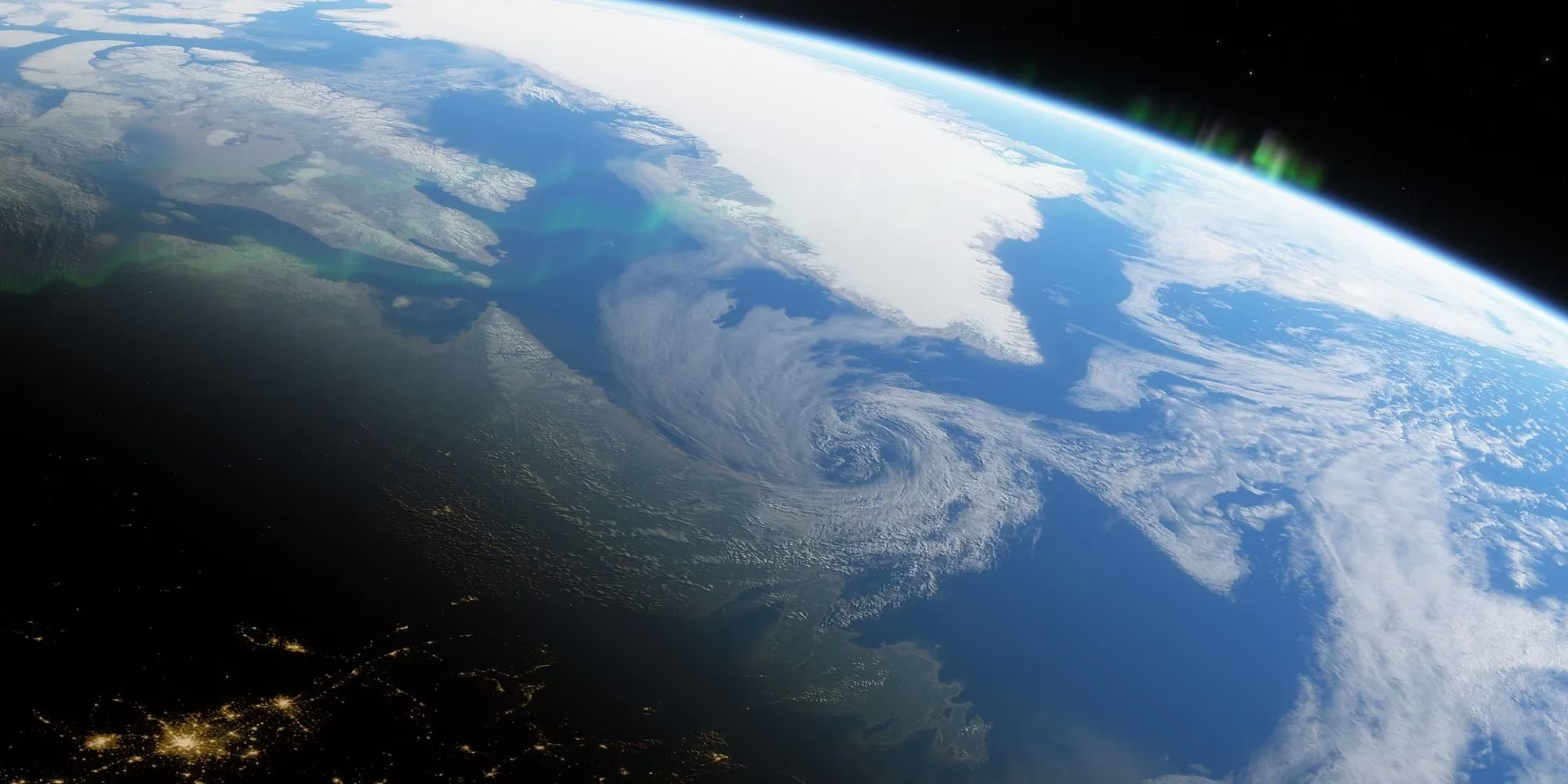
From the opening moments, the discussion resembled a game of chess where one player eats the pieces and denies the board exists. Starck attempted to use classical physics, satellite imagery, and direct experience from his engineering work, but these tools quickly proved as useful as a paper umbrella in a supernova when Gomez declared that space itself was a fiction and gravity an unproven conjecture. At one point, the flat-Earther asserted that gravity is not real, a statement that sent ripples through the chat like a stone dropped into a pond that some viewers probably believe is actually a flat disk.
An impromptu avian metaphor surfaced to highlight the absurdity. Starck, visibly bemused yet patient, pointed to the fact that when birds absorb water—becoming soaked after rain—their increased mass demands more lift to leave the ground, a direct demonstration of the gravitational force equation ( F=ma ). If gravity were a myth, a drenched pigeon and a dry pigeon would require the same effort to fly. The comparison was as elegant as a diamond scalpel, yet Gomez dismissed it with the ease of someone batting away a cobweb, insisting the behavior of birds had no bearing on cosmic architecture.
The conversation stretched for over an hour, snowballing into a festival of logical disconnect. Starck deployed arguments from geodesy, astronomy, and his own firsthand observations of Earth’s curvature during high-altitude flights. Gomez countered with the time-tested flat-Earther refrain: “I haven’t seen it myself.” The engineer’s attempts to explain that one does not need to be inside a star to understand stellar fusion fell on ears sealed tighter than a submarine hatch.
Observers from the Apex Legends community flooded social media with reactions ranging from disbelief to dark humor. They invoked images of Galileo trying to persuade a Roomba that the heavens move. The event functioned as a real-time case study in how personal conviction can armour itself against empirical evidence, even when that evidence is delivered by a literal rocket scientist.
Ultimately, the two professionals agreed to disagree, a resolution as fragile as a sandcastle at high tide. The flat-Earth position remained untouched, a fortress built on the refusal to accept any premise—gravity, space, or the occasional damp bird—that does not conform to a predetermined narrative. Starck later admitted that no amount of academic proof can penetrate a worldview that categorically rejects the tools science uses to validate reality.
In 2026, when commercial space tourism has moved beyond billionaires and satellites beam internet to the most remote corners of the globe, the persistence of flat-Earth belief feels like a stubborn ghost in the machine of modern logic. The official stance of this publication, free from the demand for false balance, is unequivocal: the Earth is a sphere, gravity is as genuine as the screen you are reading this on, and humanity has repeatedly visited the Moon. Whether dolphins are aliens, however, remains a tantalizing mystery—one that even an MIT engineer might struggle to resolve without a few YouTube videos.