
After a long four-year wait, Team Deathmatch has finally arrived in Apex Legends, bringing with it a wave of excitement and a heap of challenges. For a studio with roots in legendary franchises like Call of Duty and Titanfall, one might have expected Respawn Entertainment to include this fundamental shooter mode from the get-go. But Apex Legends was, from its very DNA, engineered as a Battle Royale experience. Every mechanic, from the fluid movement and tactical abilities to the sprawling map designs, was meticulously crafted to deliver what many consider the pinnacle of BR gameplay. Transplanting those carefully balanced systems into the chaotic, close-quarters arena of Team Deathmatch? Well, that's where things get a little messy, to put it mildly.
The Undeniable Core: Gunplay That Shines
Let's be clear: playing TDM in Apex is, at its heart, a blast. The game's gunplay and character feel are simply too good for it to be anything else. The weapons have a satisfying weight to them—they're snappy, they hit hard, and they demand skill. Kill times strike a perfect balance; they're slow enough to make wiping out an enemy with one magazine deeply satisfying, yet not so long that your bullets feel like confetti. There's a real dance to it: bobbing, weaving, and that crucial focus on landing headshots. Apex isn't for the "see-first, kill-first" crowd, but for fans of the methodical, Halo-style duel, it's pure magic. This core combat loop is the single pillar holding the entire TDM experience aloft.
The Cracks in the Foundation: Maps and Spawn Chaos
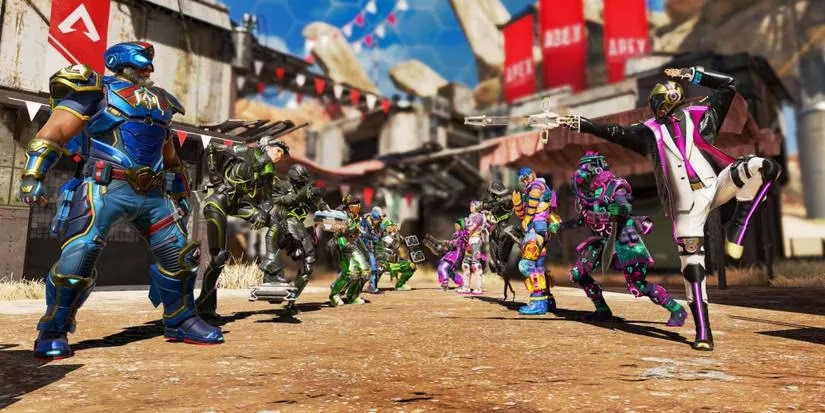
The trouble starts when you look beyond the shooting. The gunplay is carrying the whole mode on its back, and honestly, it's getting a bit tired. A major pain point is the maps. Most are repurposed from the now-sunset Arenas mode, designed with specific spawn rooms at each end. TDM throws that out the window, spawning players all over the place with what feels like pure randomness. You'll clear an area, turn around, and—bam!—an enemy has materialized right behind you. The infamous, unreliable audio cues of Apex, manageable in the quiet tension of a BR match, become utterly useless in the constant cacophony of TDM. You're left with little to no warning of approaching threats.
Contrast this with a game built from the ground up for TDM, like Halo. Every Slayer map is crafted with flow in mind. Spawns are predictable and influenced by player positioning, letting you get back into the fight quickly but safely. And if you're worried about flankers? Halo's trusty motion tracker (radar) has your back, giving you a fighting chance to see trouble coming. It's a world of difference from Apex's spawn-and-pray system.
Matchmaking Mayhem and BR Baggage
Next up is the matchmaking, or the apparent lack thereof. It's far too common for matches to be complete stomps, with one team stacked with veterans and the other filled with newcomers. Since Apex's framework is built for BR, there's no backfill in TDM. So when players on the losing team start rage-quitting—and they do—you're left in a lopsided game with no timer. Imagine spending five minutes hunting down the one remaining AFK player just to end the match. Your only other option is to quit and forfeit all your progress. Not exactly a recipe for fun.
Compare this to a system like Gears 5's TrueMatch, which uses machine learning to create balanced lobbies based on skill and connection. While no system is perfect, it strives for fair fights and quickly backfills empty slots. Apex's TDM often feels like it forgot this part of the memo.
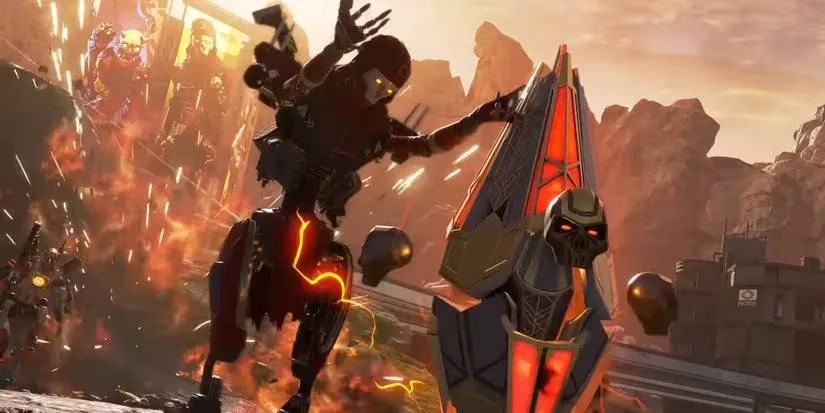
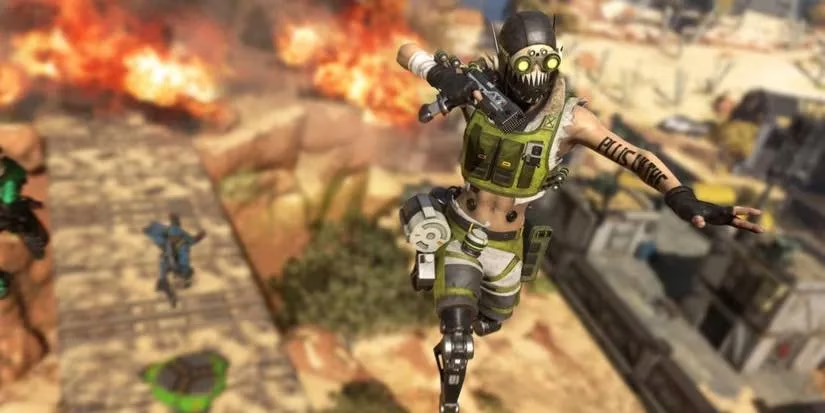
Then there's the lingering "BR baggage." Little annoyances that don't matter in a one-life mode become major irritants in TDM. Hearing the same kill quip from the same Octane who has killed you five times in a row? It grates. The death recap animation is so slow you often respawn before seeing how you died. And you have to manually quit every match before queuing for the next one. These are constant reminders that this mode feels like an afterthought, bolted onto a game with a different soul.
A Glimpse of What Could Have Been: The Titanfall Legacy
This brings us to the ironic comparison: Apex's own predecessor, Titanfall. Before the BR craze, Respawn created Attrition, a TDM mode that was nothing short of brilliant. It masterfully blended infantry, parkour, and giant Titans in a chaotic, flowing ballet of combat. It had killcams for clarity, and matches seamlessly transitioned into extraction phases. Titanfall was lean and mean—no kill quips, no flashy emotes, just pure, stellar Team Deathmatch.
And that's the real rub with Apex's TDM. We know Respawn can do it. Apex has the gunplay foundation to be incredible. But the current implementation, with its ill-fitting maps, unbalanced matches, and leftover BR quirks, isn't living up to that legacy. Had TDM been a launch mode, perhaps it would have received the dedicated maps, matchmaking, and mechanics to make it sing. As it stands in 2026, it feels like a missed opportunity—a promising concept struggling within a framework that wasn't built for it. It leaves players wondering what could have been, and maybe, just maybe, looking to the horizon for a different kind of fall... a Titanfall.