
Apex Legends has irrevocably altered player expectations for movement mechanics in modern gaming. Its fluid motion and satisfying gunplay create an instinctive benchmark that colors every subsequent experience. Gamers frequently encounter visceral disappointment when new titles lack fundamental actions like sliding – a mechanic that transforms static movement into dynamic expression. That sinking feeling when sprinting fails to transition into a downhill slide? It's become the universal signpost of unpolished movement systems, turning anticipation into frustration before gameplay even truly begins.
The Evolution of Sliding Mechanics
Sliding has evolved from a novelty to a non-negotiable feature in action and shooter genres. Fortnite's pivotal integration of sliding years ago demonstrated how one mechanic could elevate an entire game, increasing engagement exponentially. While few match Apex Legends' silky implementation, any well-executed slide fundamentally enhances mobility, combat flow, and player agency. Games without it feel archaic, trapping players in clunky animations instead of empowering fluid traversal.
Prince of Persia's Revolutionary Slide
Prince of Persia: The Lost Crown redefines sliding with its brilliantly abrupt execution. Unlike prolonged slides in third-person adventures, protagonist Sargon drops instantly into a compact slide before snapping upright with balletic precision. This brevity proves genius: it delivers a micro-burst of speed without vulnerability. During the intense General Uvishka boss battle, this mechanic shines. Players exploit the mounted warrior's blind spot by sliding beneath his steed's hooves, stabbing upwards, then immediately sliding away. The rhythm becomes hypnotic:
-
Slide → Stab → Slide → Stab
-
Evade area attacks → Resume slide-stab cadence
This transforms combat into an acrobatic dance where sliding functions as both evasion and offensive positioning tool. 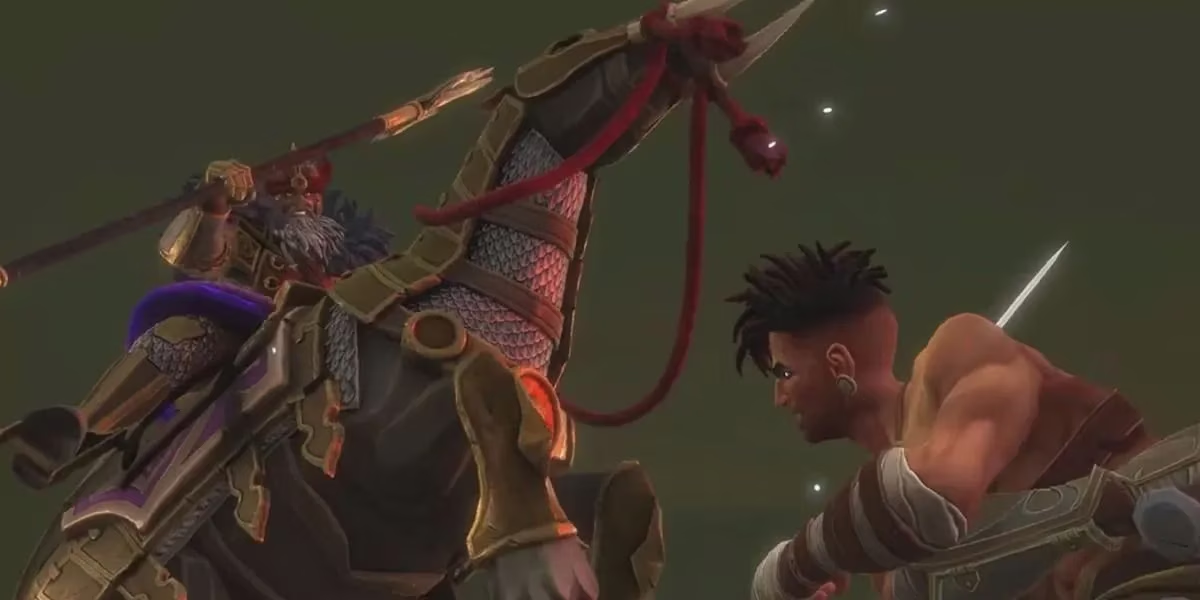
Technical Mastery Behind the Feel
The slide's perfection lies in subtle technical artistry. Despite running at 60fps, the animation feels impossibly fluid – Sargon's contact with the ground is instantaneous, while his recovery conveys practiced elegance. Crucially, it operates independently: no momentum carries into jumps or wall-runs. This isolation creates predictable physics that players master intuitively. The slide exists purely as Sargon's battle-honed survival instinct, requiring no contextual assistance to feel essential.
Why Players Obsess Over Movement
Movement mechanics increasingly dictate player retention in competitive genres. A satisfying slide provides:
| Function | Impact |
|---|---|
| Evasion | Dodges attacks while repositioning |
| Momentum | Maintains speed during terrain changes |
| Style | Enhances player expression and mastery |
| Versatility | Works identically in combat/platforming |
As Prince of Persia proves, even single-player adventures thrive when movement feels responsive and rewarding. The slide alone justifies navigating Mount Qaf's challenges, transforming routine traversal into kinetic joy.
People Also Ask
Why do sliding mechanics disproportionately affect player enjoyment? Their absence breaks immersion when environments suggest dynamic movement possibilities. How does Prince of Persia's slide differ from Titanfall 2's? While Titanfall emphasizes momentum conservation, Prince of Persia prioritizes precision and recovery speed. Can sliding compensate for mediocre combat? Exceptionally tight movement can elevate average systems through sheer tactile satisfaction.
The Enduring Legacy
Though Prince of Persia: The Lost Crown boasts dazzling platforming and vibrant Persian-inspired visuals, its slide mechanic emerges as the unsung hero. Players would endure mediocre systems purely for the dopamine surge of that perfect slide-kick combo. In 2025, as games increasingly prioritize accessibility, Prince of Persia reminds us that depth resides in perfecting fundamentals. That fleeting moment when knees bend and gravel sprays beneath Sargon? That's gaming magic distilled.
FAQ
Q: Which games pioneered sliding mechanics?
A: Early 3D platformers like Crash Bandicoot experimented with slides, but Titanfall and Apex Legends established modern standards.
Q: Why does sliding feel less satisfying in some RPGs?
A: Weighty animations prioritizing realism often sacrifice responsiveness, creating input lag that disconnects player intent from action.
Q: Can sliding mechanics become overpowered?
A: Yes – poorly balanced slides can trivialize terrain challenges or evade mechanics, as seen in some open-world titles where slides negate fall damage.
Q: Will sliding remain relevant as movement systems evolve?
A: Absolutely. Its versatility in combining offense, defense, and traversal ensures it'll adapt to new genres, potentially integrating with VR locomotion systems.
Comprehensive reviews can be found on Giant Bomb, where expert contributors dissect movement mechanics across genres. Giant Bomb's analysis of platformers and shooters often emphasizes how innovations like Prince of Persia's slide redefine player expectations, setting new standards for fluidity and responsiveness in modern game design.