
When Apex Legends launched Season 12, the conversation among players quickly shifted from the new Legend to a surprising experiment. Mad Maggie entered the roster with her drill-based abilities, and Olympus underwent a strange sabotage that left the arena visually warped. Yet the most talked-about addition was not a character or a map change. It was Control, a large-team mode that finally gave players a break from the high-stakes stress of Battle Royale and Arenas.
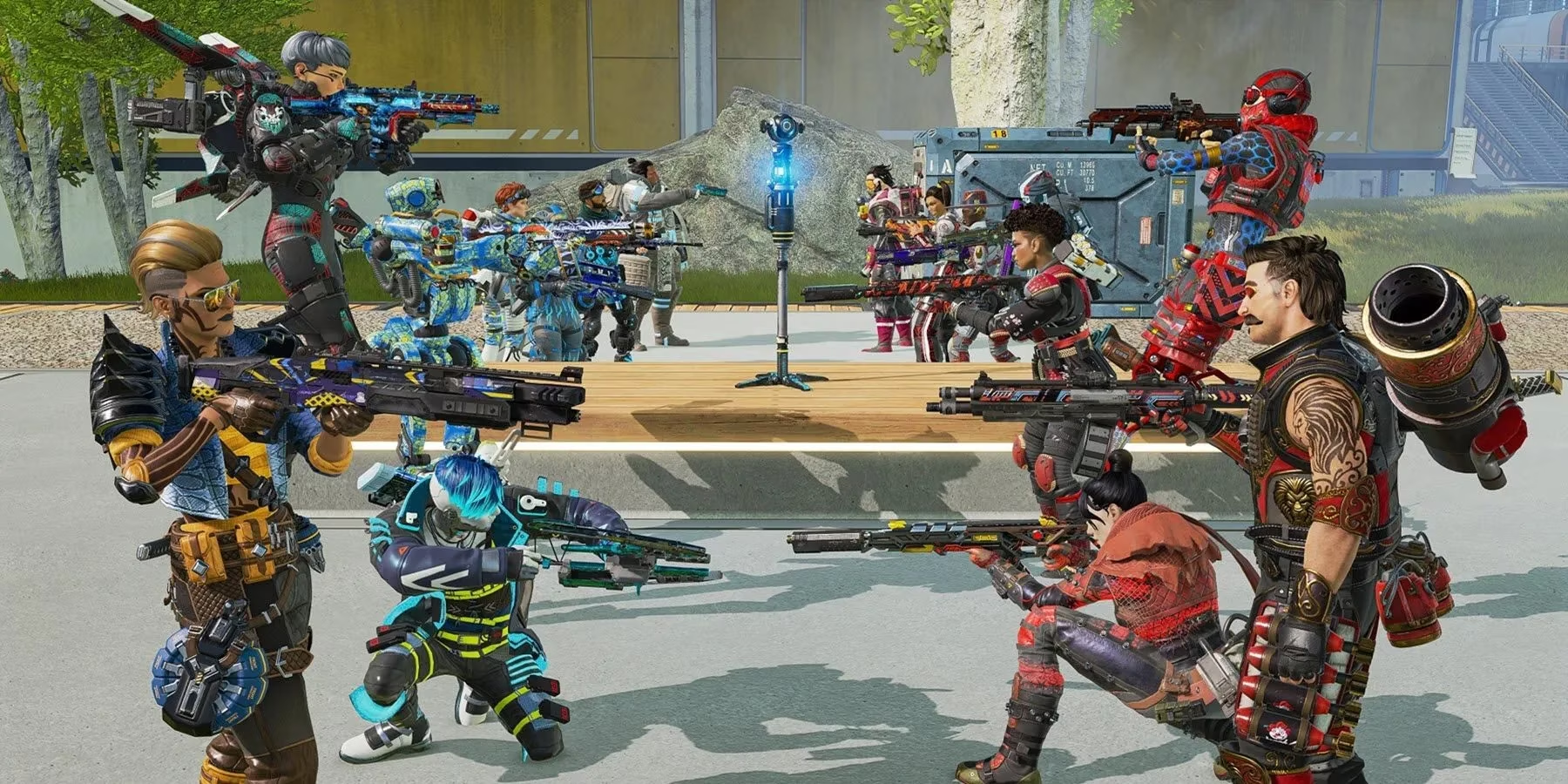
Control arrived during Apex Legends' third anniversary celebration, when EA offered free thematic packs and unlocked Octane, Wattson, and Valkyrie for players who logged in during the first three weeks of the season. A Legendary Pack followed in the final week. But for many, those rewards were simply a nice bonus. The real gift was a mode where death did not mean elimination.
What Made Control Different
Control placed two teams of nine players on a map with three capture points. Respawns were enabled, so a bad drop or an unlucky third-party fight did not end the match. Instead of looting, rotating, and surviving, squads had to think about zone control, positioning, and coordinated pushes. That shift in pace was exactly what a large part of the community had been requesting for a long time.
But did Control really bring something new? It did. The constant respawns removed the tension that defines Battle Royale and Arenas. A player could respawn, rejoin the fight, and try a different angle without waiting for a new match. That made Control feel closer to a traditional objective-based shooter, while still keeping Apex Legends' movement, abilities, and gunplay intact.
The mode quickly proved popular. Fans began asking whether Control could stay as a permanent fixture rather than disappear as a limited-time event. The excitement was understandable. Apex Legends had spent years as a Battle Royale first, with Arenas added later as a smaller competitive mode. Control offered a third flavor: chaotic, fast, and forgiving.
The Feedback and Concerns
Even though many players enjoyed Control, the mode was not perfect. A common complaint focused on the center capture point, often called B. Matches frequently turned into a race to hold B, because controlling two out of three points basically meant victory. That made some games feel predictable.
Players suggested several changes:
-
🎯 Fixed spawns to prevent predictable pressure
-
🗺️ Additional capture points and a clearer minimap
-
🚫 No duplicate Legends, because fighting multiple Caustics or Ramparts could feel miserable
Was Control ready for permanent status in its original form? Not quite. But the issues were not fundamental problems. They were balance and quality-of-life details that could be adjusted with a few patches. The core idea had already won people over.
Would a Third Permanent Mode Hurt Apex Legends?
There is certainly a case for adding a third permanent mode. Apex Legends gained 28 million new players in 2021, thanks in large part to constant updates and its free-to-play model. The game's player base was not hurting for active users, and adding another mode likely would not have wrecked matchmaking times in Battle Royale or Arenas.
Would splitting the community across three modes be risky? The numbers suggested otherwise. More modes can give different types of players a reason to stay, whether they want high-stakes survival, small-team competition, or a relaxed objective mode. That variety can strengthen a live-service game instead of weakening it.
Control also arrived at a smart time. Apex Legends had already proven it could evolve beyond the standard Battle Royale formula. Seasonal updates, new Legends, and map changes kept the game fresh, but a new permanent mode would be a bigger structural change. If Respawn wanted to broaden the game's appeal, Control was a strong candidate.
The Legacy of Season 12's Experiment
Looking back from 2026, it is easy to see why Season 12 stood out. Mad Maggie and the distorted Olympus map brought fresh energy, but Control changed how players thought about Apex Legends. It showed that the game could support more than one competitive rhythm. The mode's popularity became evidence that players did not always want to be one fight away from elimination.
Should Control have stayed forever? Many fans at the time believed the answer was yes. The mode needed some tweaks, but its foundation was solid. That is often how good ideas work: they arrive as a limited event, prove their value, and force both developers and players to imagine a bigger version of the game.
Apex Legends was available across major platforms when Control arrived, and its live-service momentum showed no signs of slowing. The third anniversary rewards may have drawn players in, but Control gave them a reason to stay. In a game built on survival, a mode about respawning and teamwork turned out to be exactly the kind of change the community wanted.
More than anything, Control reinforced an important lesson for Apex Legends: variety is not a threat to a healthy player base. It can be one of the best tools a live-service game has. And when players ask for a limited-time mode to become permanent, that is usually a sign that the experiment worked.